Listening More Clearly to the Universe
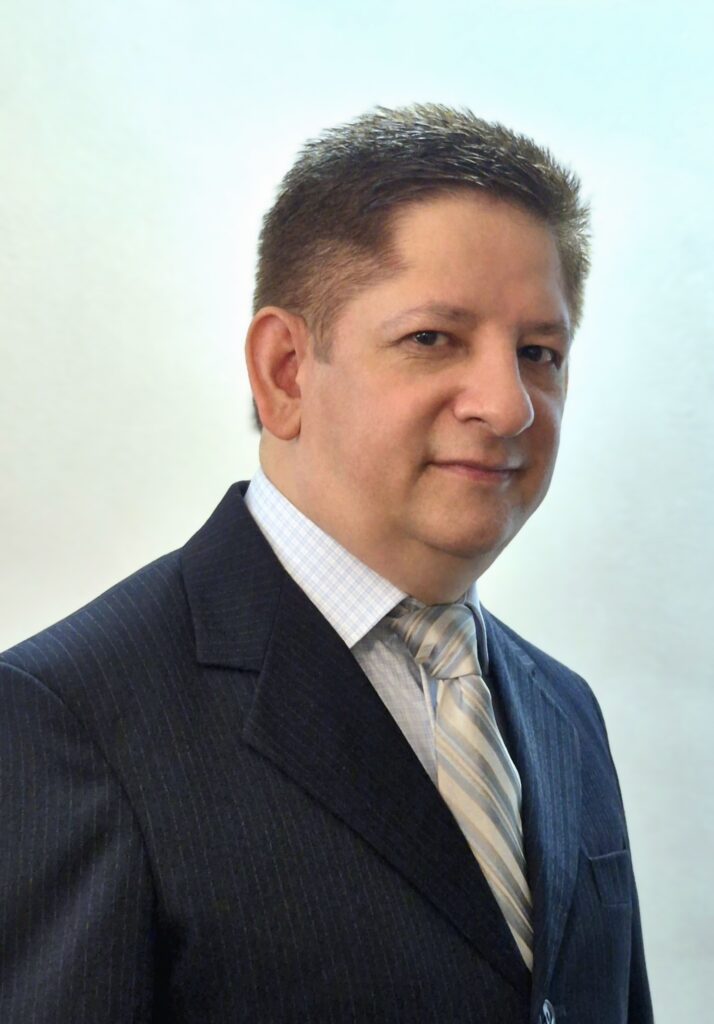
Doctoral candidate Yohan Aparicio, under the supervision of Professor Manuel Jiménez and as part of the NSF CARSE R2 Thrust (Reconfigurable Computational Structures for Signal Processing) research efforts, has published a new article in the prestigious Publications of the Astronomical Society of the Pacific (PASP).
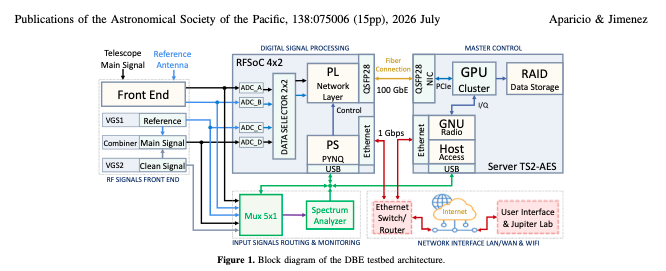
The paper, entitled “A Heterogeneous Testbed Architecture for Real-time Adaptive RFI Mitigation in Radio Astronomy Receivers,” addresses one of the most pressing challenges in modern radio astronomy: recovering faint cosmic signals in real time from interference generated by increasingly pervasive wireless technologies.
The research presents and demonstrates a novel computing platform capable of identifying and mitigating radio-frequency interference (RFI) in real time. By combining reconfigurable hardware and high-performance computing resources, the proposed architecture improves performance, scalability, and resource efficiency while enabling the effective recovery of astronomical signals.
Built using commercial-off-the-shelf components, the platform provides a flexible, cost-effective, and modular framework for advancing research in real-time RFI mitigation. The architecture also supports the development of next-generation instrumentation for radio astronomy receivers.
This publication highlights ongoing research within the NSF CARSE R2 Thrust, focused on Reconfigurable Computational Structures for Signal Processing, and its contribution to developing technologies that can help improve the observation and recovery of astronomical signals in increasingly complex radio-frequency environments.
Read the publication:
A Heterogeneous Testbed Architecture for Real-time Adaptive RFI Mitigation in Radio Astronomy Receivers