Gabriela Farfán-Enríquez Presents CARSE Research on Self-Supervised Learning for RFI Detection at SIDIM 2026
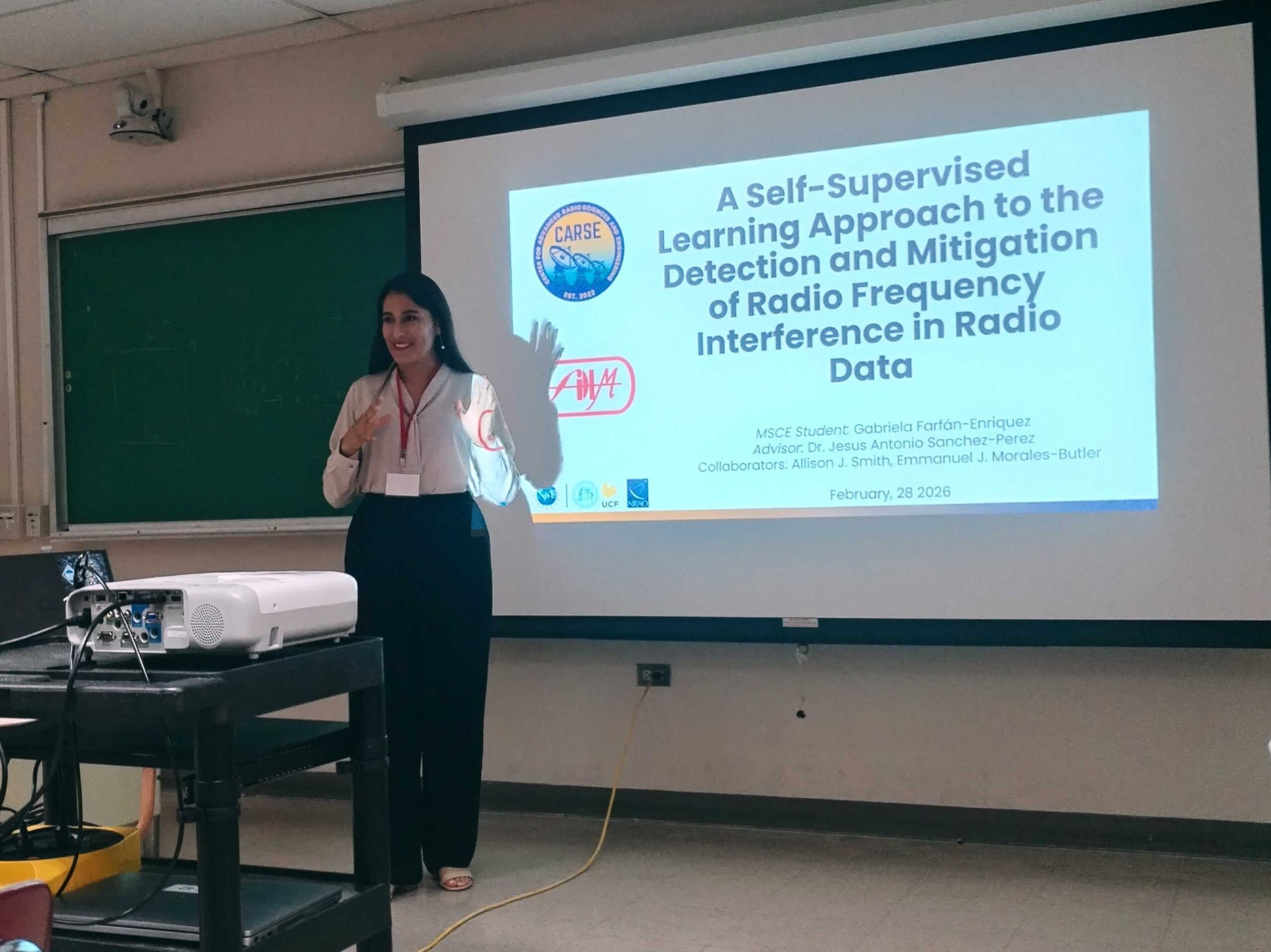
The Center for Advanced Radio Sciences and Engineering (CARSE) proudly highlights the participation of Gabriela Farfán-Enríquez, M.S. student in Computer Engineering (MSCE) at the University of Puerto Rico at Mayagüez (UPRM), at the 41st Interuniversity Mathematical Sciences Research Seminar (SIDIM 2026) held at the University of Puerto Rico, Río Piedras Campus.
At SIDIM 2026, Gabriela presented her research titled:
“A Self-Supervised Learning Approach to the Detection and Mitigation of Radio Frequency Interference in Radio Data.”
Her work addresses one of the major challenges in radio astronomy: Radio Frequency Interference (RFI). RFI consists of artificial signals originating from radar systems, satellites, communication devices, and other human-made sources that contaminate astronomical observations, leading to data degradation and masking of true celestial signals.
Research Overview
This study investigates the use of Self-Supervised Learning (SSL) as a scalable solution for detecting RFI in unlabeled radio astronomy datasets. Unlike supervised learning approaches, which require manually labeled spectrograms, SSL extracts meaningful representations directly from the data without predefined labels.
Gabriela utilized observational data from the Arecibo Observatory, stored in FITS format, and applied a comprehensive preprocessing pipeline including:
- Polarization separation
- Time segmentation
- Radial velocity band filtering (LSR-based)
- Image normalization and resizing
For feature extraction, the research employed DINOv3, a Vision Transformer (ViT)-based self-supervised model. DINOv3 enables the extraction of high-dimensional embeddings capable of capturing:
- Spectral patterns
- Frequency continuity
- Edges and anomalies
- Structural variations associated with RFI
To analyze the embedding space, dimensionality reduction and clustering techniques such as PCA, t-SNE, K-Means, and HDBSCAN were applied. Preliminary results demonstrate that density-based clustering methods (e.g., HDBSCAN) are particularly effective at identifying natural RFI patterns without imposing rigid cluster boundaries.
Impact and Future Work
This research represents a promising step toward automated RFI detection and mitigation in radio astronomy. By reducing dependence on labeled datasets and expert annotation, self-supervised learning approaches can significantly improve scalability and robustness.
Ongoing work includes:
- Fine-tuning the DINOv3 model for improved RFI detection
- Expert-assisted validation of clustering results
- Integration of automated mitigation strategies
Gabriela’s research is conducted under the supervision of Dr. Jesús Antonio Sánchez-Pérez, with collaborators Allison J. Smith and Emmanuel J. Morales-Butler.
We congratulate Gabriela for representing CARSE at SIDIM 2026 and for contributing to interdisciplinary research at the intersection of radio science, machine learning, and signal processing.