
NSF CARSE Researchers Present Advances in Antennas and Radio Science at IEEE AP-S/URSI 2026
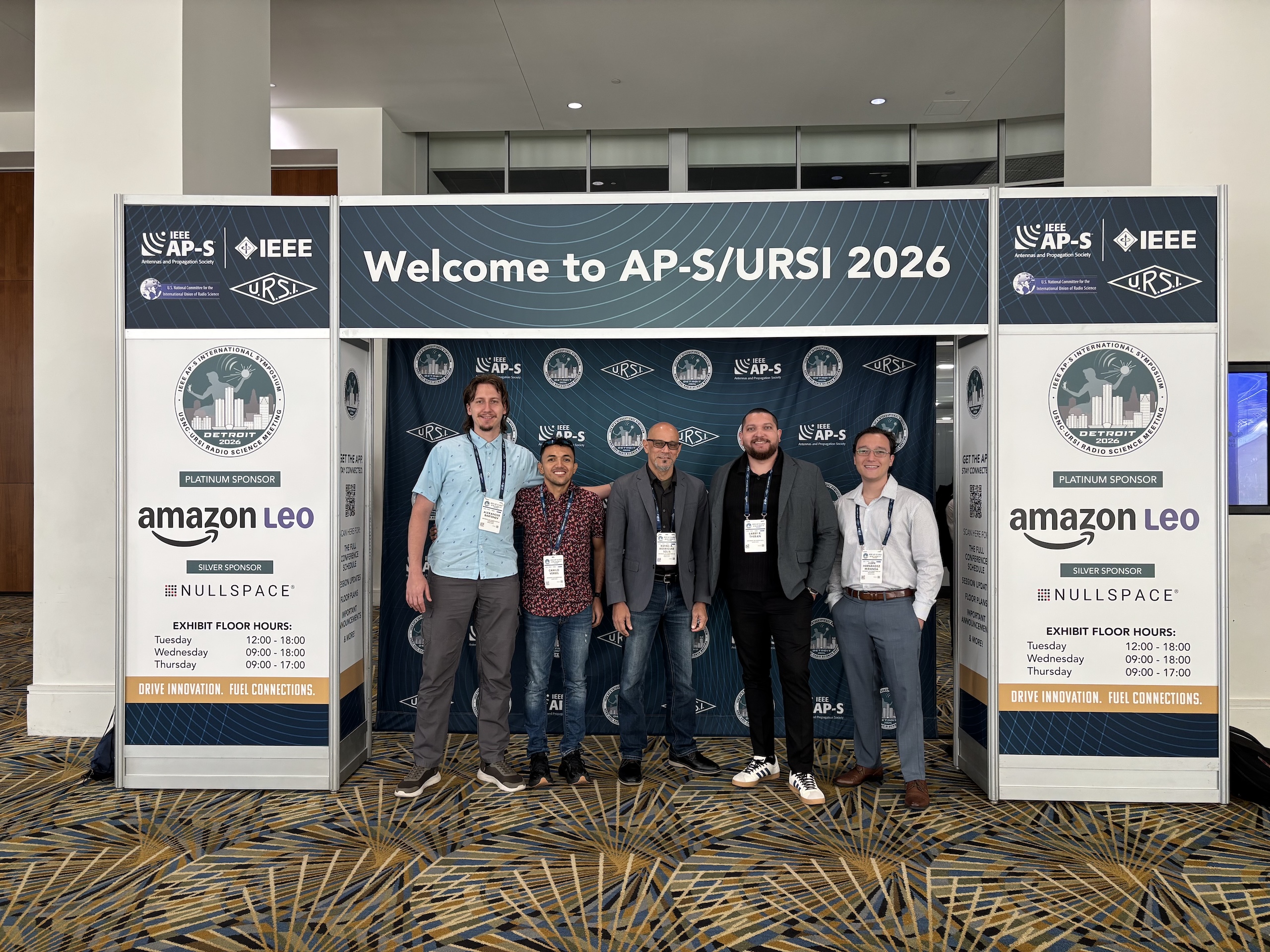
The U.S. National Science Foundation Center for Advanced Radio Sciences and Engineering (NSF CARSE) at the University of Puerto Rico at Mayagüez participated in the 2026 IEEE International Symposium on Antennas and Propagation and USNC-URSI Radio Science Meeting, held from July 12–17 in Detroit, Michigan.
The international conference brought together scientists, engineers, researchers, and students to present and discuss advances in antennas, propagation, electromagnetics, and radio science.
NSF CARSE Director Dr. Rafael A. Rodríguez Solís, together with NSF CARSE students and researchers Alexander Bartenev, Larry R. Theran, Camilo A. Verbel, and Juan E. Hernandez-Miranda, participated in the conference, where research developed in collaboration with Dr. Rodríguez Solís was presented across several areas of antenna and high-frequency engineering.
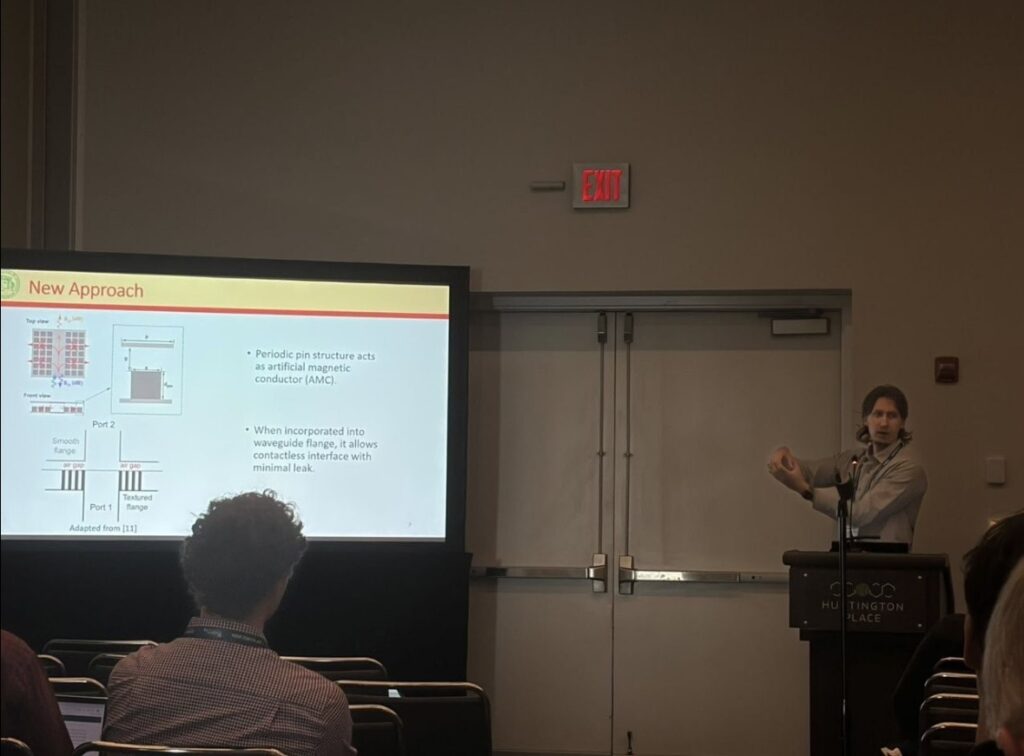
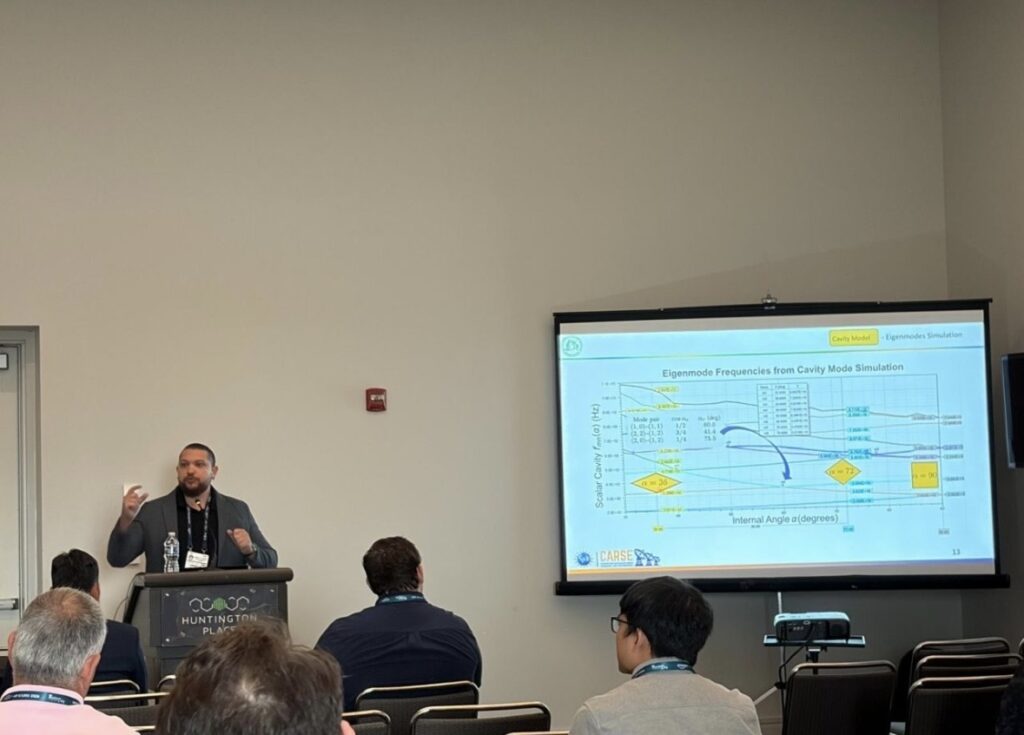
High-Frequency Material Characterization and Penrose Rhombus Antenna Tiles
Alexander Bartenev and Larry R. Theran presented two research works developed in collaboration:
“High-Frequency Characterization of Thin-Film Materials Using a Contactless Pin-Flange Waveguide System”and “Angle-Dependent Modal Coupling in Penrose Rhombus Antenna Tiles.”
Their participation provided an opportunity to share NSF CARSE research with the international antennas and propagation community while exchanging ideas with researchers working on emerging developments in the field.
Both papers are expected to become available through IEEE Xplore.
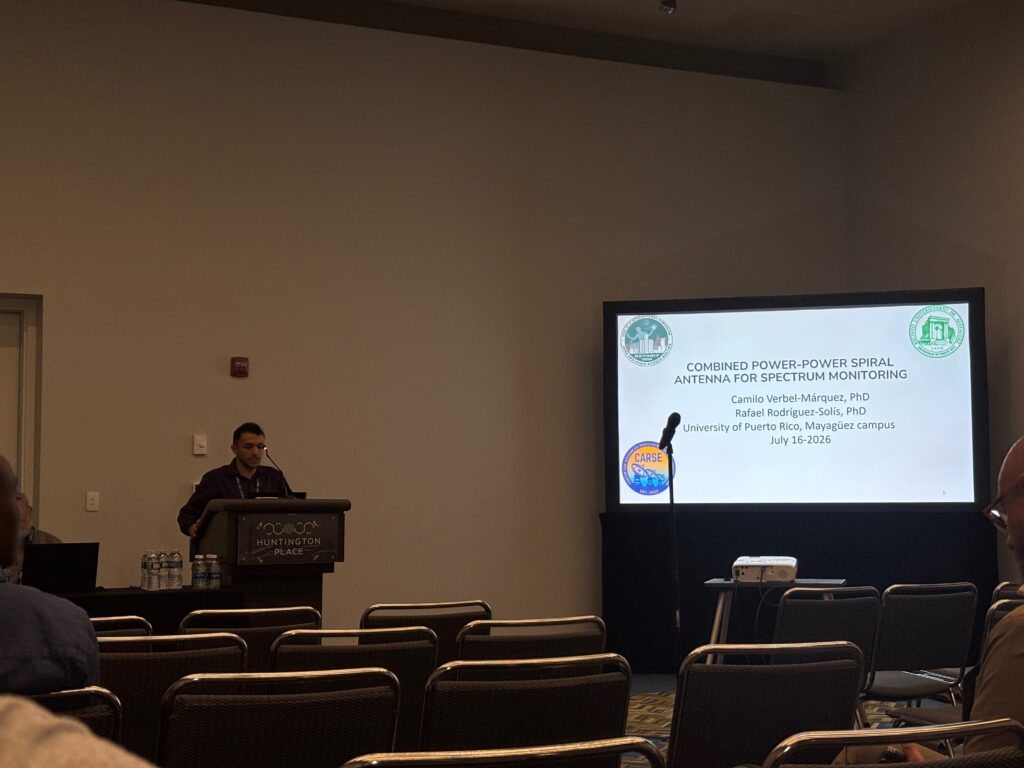
Combined Power-Power Spiral Antenna for Spectrum Monitoring
Camilo A. Verbel presented research on a combined power-power two-arm spiral antenna for spectrum monitoring.
The proposed antenna combines two different power-law exponents within a two-arm spiral design backed by a conducting cavity. The antenna was simulated across the 1–15 GHz frequency range, demonstrating broadband performance for potential spectrum-monitoring applications.
Simulation results showed maximum gains of 9.6 dB at 5.375 GHz, 7.8 dB at 8.0 GHz, and 5.2 dB at 13.25 GHz, with a -7 dB bandwidth extending from 1.76 GHz to 14.12 GHz.
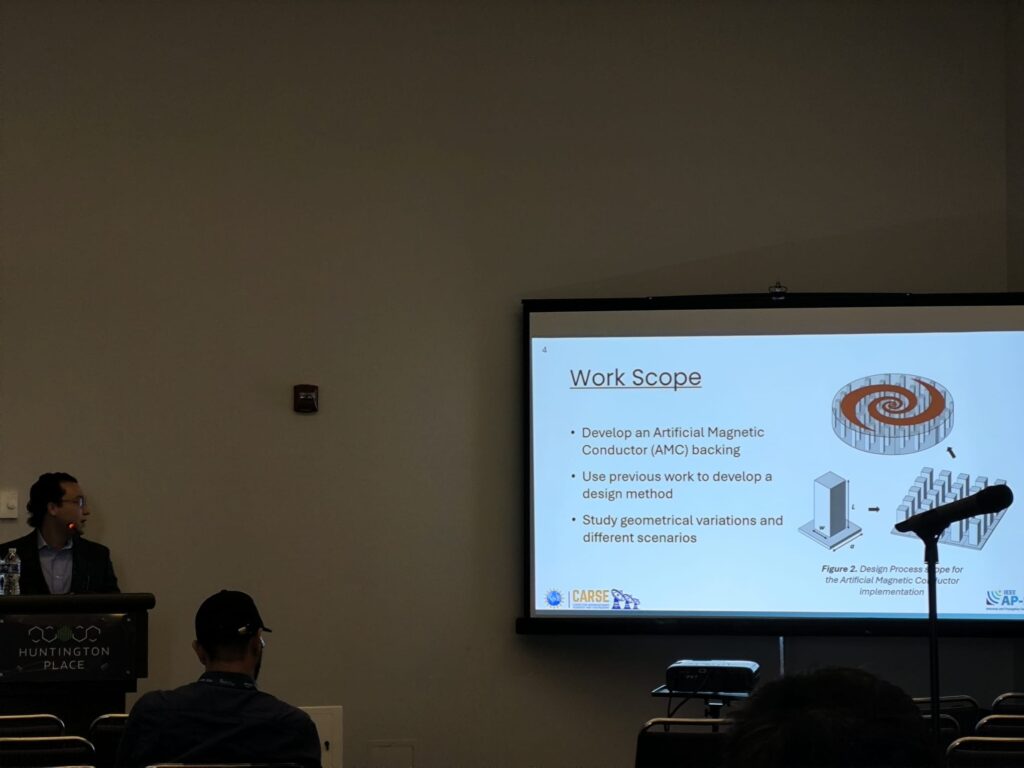
Unbalanced Two-Arm Equiangular Spiral Antenna Using Artificial Magnetic Conductor Backing
Juan E. Hernandez-Miranda presented:
“Unbalanced Two-Arm Equiangular Spiral Antenna Using Artificial Magnetic Conductor Backing.”
The research included a parametric study of the pin period, cross-section, and length of an Artificial Magnetic Conductor (AMC) surface to support its implementation at millimeter-wave frequencies.
The study found that pin length had a greater effect on AMC performance than the lattice constant. These findings were then applied to the design of an unbalanced-fed, two-arm equiangular spiral antenna with AMC backing.
The resulting antenna demonstrated an impedance bandwidth from 20 to 30 GHz, with a peak gain of 9.5675 dBc at the central frequency.
Advancing NSF CARSE Research Through Scientific Exchange
Participation in IEEE AP-S/URSI 2026 provided NSF CARSE researchers with an opportunity to present their work to an international scientific community, engage with experts in antennas, propagation, and radio science, and learn about current developments across these research areas.
Through the participation of its students, researchers, and Director, NSF CARSE continues to contribute to the advancement of radio sciences and engineering while creating opportunities for its research community to share its work in major scientific forums.